
Over the past decade, digital governance has transformed how governments deliver services. Paper-based systems have largely been replaced by online portals promising faster, more transparent, and more convenient access.
Yet, despite this progress, users still face a common frustration—managing multiple logins across different government platforms. Different usernames, multiple passwords, repeated verification steps… it often feels more complicated than it should be.
So the real question is: If governance is digital, why isn’t it simple?
This is where Single Sign-On (SSO) becomes a game-changer.
The Problem with Multiple Logins in Government Services
Let’s consider a typical scenario. You want to:
- Apply for a government job
- Check tax records
- Pay utility bills
- Access welfare schemes
Now imagine needing separate accounts for each service.
This fragmented system creates several challenges:
1. Time-Consuming Processes
Users often spend more time recovering passwords than accessing services.
2. Increased Security Risks
Managing multiple passwords leads to:
- Weak password choices
- Password reuse
- Higher chances of breaches
3. Low Digital Adoption
When systems feel complex, many users prefer offline methods, defeating the purpose of digitization.
Clearly, digitization alone is not enough—simplicity is essential.
What Is Single Sign-On (SSO)?
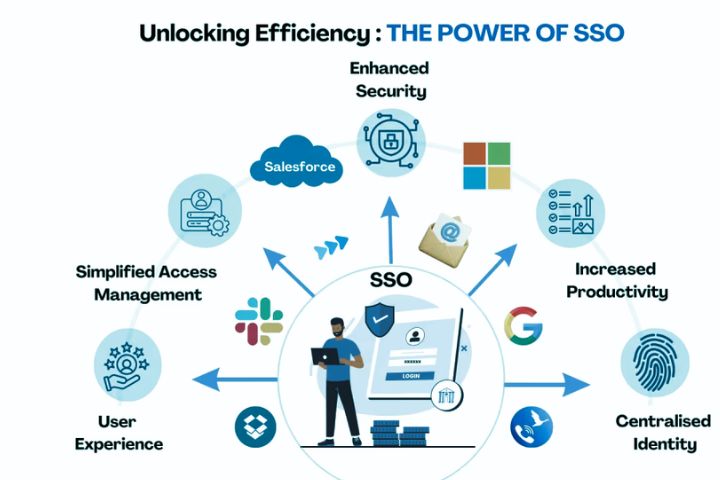
Single Sign-On (SSO) allows users to access multiple government services using one secure login ID.
Think of it as a master key:
- One login
- Multiple services
- Seamless experience
Once authenticated, users can navigate across platforms without logging in again.
Why SSO Is Better Than Traditional Login Systems
1. Seamless User Experience
No more remembering multiple credentials. One login simplifies everything.
2. Faster Access
Users can switch between services instantly without repeated authentication.
3. Consistent Interface
A unified login system creates a familiar and easy-to-use experience across platforms.
4. Improved Accessibility
Even users with limited digital knowledge can easily adapt to a single system.
How SSO Improves Security
At first, relying on a single login might seem risky. But modern SSO systems are actually more secure than multiple login systems.
Key Security Benefits:
- Multi-Factor Authentication (MFA) adds an extra layer of protection
- Centralized monitoring detects suspicious activity quickly
- Reduced attack surface means fewer entry points for hackers
- Strong encryption protocols ensure data safety
Unlike fragmented systems where security varies, SSO ensures uniform, high-level protection.
Benefits of SSO for Governments
SSO doesn’t just improve user experience—it also boosts administrative efficiency.
1. Better Data Integration
Departments can securely share data, reducing duplication and errors.
2. Lower Operational Costs
Maintaining one authentication system is more cost-effective than managing many.
3. Faster Service Delivery
With integrated systems, processes become quicker and more efficient.
4. Increased Transparency
Centralized access makes tracking and auditing easier, improving accountability.
Why Users Prefer Unified Login Systems
From a user perspective, simplicity is everything.
SSO provides:
- Less confusion
- Faster access
- Greater trust in digital systems
When platforms are easy to use, users are more likely to:
- Engage regularly
- Adopt digital services
- Recommend them to others
The Role of SSO in the Future of Digital Governance
As governments move toward smarter systems, integration becomes crucial.
SSO supports:
- Scalability – easily add new services without new logins
- AI and data analytics – better insights through connected systems
- User-centric design – smoother digital journeys
In short, SSO is not just a feature—it is the foundation of modern e-governance.
Are Multiple Login Systems Becoming Obsolete?
While some legacy systems may still exist, their limitations are clear:
- Complex user experience
- Higher security risks
- Inefficient operations
In comparison, SSO aligns perfectly with modern needs:
- Simplicity
- Security
- Efficiency
The shift toward unified login systems is not just a trend—it’s a necessity.
Conclusion
Digital governance is evolving beyond just putting services online. The focus is now on making them:
- Easy to use
- Secure
- Accessible to everyone
Multiple login systems fall short on all these fronts.
Single Sign-On (SSO) solves these challenges by:
- Simplifying access
- Strengthening security
- Improving efficiency
Most importantly, it builds trust, which is the backbone of any successful digital ecosystem.
As governments continue to innovate, SSO will play a central role in shaping the future of governance.






![TamilRockers Proxy 11 Mirror-Sites [Updated 2022] & How to Unblock It](https://www.techsplashers.com/wp-content/uploads/2022/01/TamilRockers-Proxy-11-Mirror-Sites-Updated-2022-How-to-Unblock-It.jpg)
Leave a Reply