
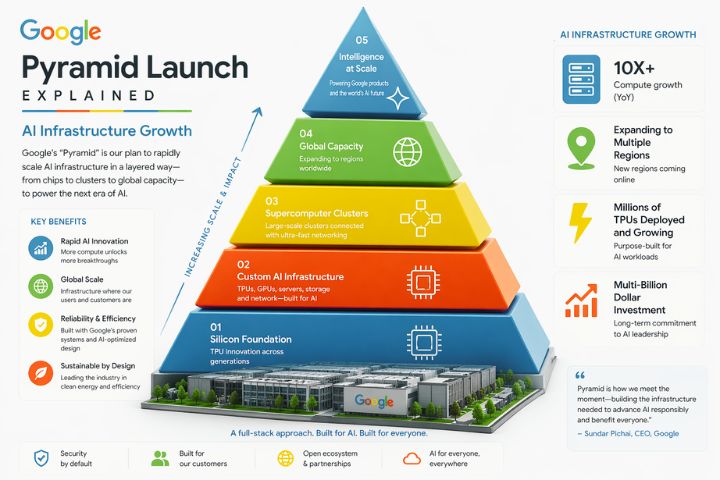
The phrase “Google Pyramid Launch” has recently surfaced in tech conversations. Although Google has not officially introduced a product by this name, industry experts use it to describe a large-scale infrastructure initiative—often linked to “Project Pyramid”—focused on expanding data centers to support AI and cloud services.
This development reflects a wider industry trend: major technology companies are rapidly scaling their infrastructure to meet increasing demand for artificial intelligence, cloud computing, and digital connectivity worldwide.
Breaking Down the Google Pyramid Idea
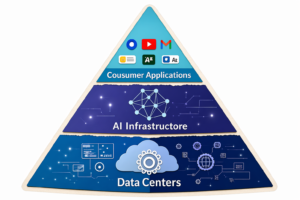
Google’s infrastructure can be thought of as a layered pyramid structure:
Foundation Layer
This includes physical infrastructure such as data centers, servers, storage systems, and networking hardware.
Middle Layer
Here you find AI systems, analytics platforms, and cloud computing frameworks.
Top Layer
This layer consists of end-user services like search engines, video platforms, productivity tools, AI assistants, and SaaS applications.
This model highlights why strong infrastructure is essential—advanced AI services cannot function efficiently without a powerful underlying base.
Overview of Project Pyramid Data Centers
One of the most talked-about developments is a large-scale data center campus located in West Memphis, Arkansas, believed to be connected to this initiative.
Notable features include:
- Five large data center facilities
- Over 1,000 acres of land
- Investment worth billions of dollars
- Integration of renewable energy sources
- Designed to handle AI-focused cloud workloads
This project signals a major step forward in hyperscale computing capacity.
Key Drivers Behind the Expansion
Rapid Growth of AI
Artificial intelligence is expanding at an unprecedented pace and requires significant computing power. Modern AI systems rely on:
- High-performance GPUs
- Advanced cooling technologies
- Large-scale data storage
- High-speed networking
Where traditional data centers once operated at around 30 MW, newer AI-driven facilities often exceed 200 MW.
Rising Energy Demand
As AI workloads grow, energy consumption is increasing sharply. Google’s data center power usage has significantly risen in recent years.
This creates several challenges:
- Higher operational costs
- Environmental concerns
- Need for energy-efficient innovations
Global Data Center Trends
Understanding these developments helps businesses and professionals stay aligned with future technology shifts.
Cloud Infrastructure Insights
| Metric | Value |
| Global cloud data center electricity use | ~460 TWh |
| Share of global electricity | ~2% |
| Google Cloud efficiency improvement | ~7.3% annually |
| Renewable energy matching | 100% electricity |
- Global data centers consume around 460 TWh of electricity
- This accounts for roughly 2% of total global energy usage
- Cloud efficiency continues to improve annually
- Many providers aim to match energy use with renewable sources
These figures highlight the massive scale of modern cloud infrastructure.
Competition Among Tech Giants
| Company | Cloud Market Share | AI Focus |
| AWS | ~30% | AI chips + cloud |
| Microsoft Azure | ~20% | OpenAI partnership |
| Google Cloud | ~13% | TPU + Gemini AI |
| Others | ~37% | Mixed players |
Large technology companies are heavily investing in infrastructure, creating intense competition in the cloud and AI space. This rivalry drives continuous innovation and expansion.
Business Impact of Infrastructure Expansion
For Businesses
Organizations benefit from:
- Faster computing performance
- Enhanced data analytics capabilities
- AI-powered automation
- Global scalability
This leads to cost savings and improved efficiency.
For Developers
Developers gain access to:
- More powerful APIs
- Faster machine learning deployment tools
- Advanced cloud environments
These improvements help speed up innovation and development cycles.
For Consumers
End users experience:
- Quicker search results
- More intelligent digital assistants
- Better-performing apps
Most of these improvements happen behind the scenes.
Environmental Considerations
| Area | Impact |
| Automation | Reduced manual work |
| Marketing | Global reach |
| Analytics | Better decisions |
| Cloud | Scalability |
| AI Tools | Productivity boost |
The growth of AI infrastructure raises sustainability concerns.
Future projections suggest:
- Data center energy consumption could reach around 945 TWh by 2030
- Cooling technologies and renewable energy will play a critical role
- Advanced cooling methods can cut energy use significantly
Sustainability is becoming a top priority in infrastructure planning.
Economic Impact of Large Data Centers
Major infrastructure projects contribute to:
- Job creation
- Local economic growth
- Improved digital ecosystems
- Increased investment opportunities
Projects like these often bring substantial economic benefits to their regions.
Challenges in Scaling Infrastructure
Energy Usage
AI-driven systems require large amounts of electricity, increasing both cost and complexity.
Data Security and Privacy
As more data is processed, companies must address:
- Stronger security requirements
- Regulatory compliance
- Data protection concerns
Market Competition
Technology companies are under pressure to innovate due to competition from other cloud and AI providers.
Future Trends
Continued AI Infrastructure Growth
Expect to see:
- Larger and more advanced data centers
- Greater use of renewable energy
- Development of specialized AI hardware
Expansion of Edge Computing
Processing data closer to users will reduce delays and improve performance.
Evolution of Cloud Ecosystems
Cloud platforms will:
- Expand their global reach
- Become more cost-effective
- Integrate deeper AI capabilities
Practical Insights for Businesses
To stay competitive:
- Adopt cloud technologies to reduce infrastructure costs
- Leverage AI tools for automation and efficiency
- Track industry trends to anticipate changes
- Develop data skills for better decision-making
Frequently Asked Questions
Is Google Pyramid an official product?
No, it’s an informal term used to describe infrastructure expansion efforts.
Why is Google investing in data centers?
To support AI, cloud services, and increasing digital demand.
Will this impact everyday users?
Yes, indirectly through faster and smarter digital services.
Is AI infrastructure environmentally sustainable?
Companies are actively working toward sustainability using renewable energy and efficient systems.
Conclusion
The concept of the Google Pyramid reflects a larger shift toward AI-driven infrastructure and cloud expansion. Massive investments in data centers are shaping the future of technology by enabling faster computing, smarter applications, and scalable digital platforms.
For businesses, developers, and tech enthusiasts, understanding these trends is essential. Infrastructure advancements influence everything from pricing and performance to innovation and digital transformation.
As artificial intelligence continues to evolve, projects like these will form the backbone of the next generation of the digital economy.








![TamilRockers Proxy 11 Mirror-Sites [Updated 2022] & How to Unblock It](https://www.techsplashers.com/wp-content/uploads/2022/01/TamilRockers-Proxy-11-Mirror-Sites-Updated-2022-How-to-Unblock-It.jpg)
Leave a Reply